Real estate newsletter - latest articles.
h1 style="text-align:center;">Real Estate Newsletter – August 2026

In This Issue:

  1. Essential Tips for Buying in a Competitive Market
    Learn how to prepare, move quickly, and make stronger decisions when homes are selling fast.
    Read More »

  2. Appraisal 101: How It Works and How to Prepare
    Understand what appraisers look for and why the appraisal can affect the outcome of a sale.
    Read More »

  3. Going Green? What You Need to Know About Energy-Efficient Homes
    See how energy efficiency can affect comfort, costs, resale value, and long-term ownership decisions.
    Read More »


Essential Tips for Buying in a Competitive Market

Buying a home in a competitive market can feel stressful, especially when good properties attract multiple offers quickly. Buyers may feel pressured to move fast, stretch their budget, or make decisions before they feel fully ready. The key is not to panic. The strongest buyers prepare before the right property appears, understand what matters to sellers, and make offers that are both competitive and responsible. This report explains how buyers can improve their chances without making reckless decisions.

1. Get Fully Prepared Before You Start Touring

In a competitive market, preparation matters more than speed alone. Buyers should have mortgage pre-approval, proof of funds, a clear budget, and a realistic understanding of closing costs before viewing serious properties. If buyers wait until they find a home to organize financing, they may lose valuable time. A prepared buyer can act quickly without feeling rushed because the major financial questions have already been answered.

2. Know Your Maximum Number Before Emotions Take Over

Competition can make buyers feel like they need to keep increasing their offer. Before entering any bidding situation, buyers should decide their true maximum price. This number should reflect not only what the lender may approve, but what the buyer can comfortably afford after accounting for taxes, insurance, utilities, maintenance, and lifestyle needs. Knowing the limit in advance helps prevent emotional overbidding and post-purchase regret.

3. Understand The Local Market Before Making An Offer

A strong offer is based on evidence, not guesswork. Buyers should review recent comparable sales, average days on market, list-to-sale price ratios, and current inventory. Some properties are priced low to attract multiple offers, while others may already be close to market value. Understanding the local pricing strategy helps buyers avoid both underbidding and overpaying.

4. Be Ready To Move Quickly, But Not Carelessly

Competitive markets reward buyers who can act decisively. However, acting quickly does not mean ignoring important details. Buyers should review property disclosures, ask questions, understand included items, and consider potential repair or maintenance concerns. A fast decision should still be an informed decision. Good preparation makes that possible.

5. Make Your Offer Clean And Clear

Sellers often prefer offers that are easy to understand and likely to close. A clean offer may include a strong deposit, clear timelines, flexible closing terms, and only necessary conditions. Buyers should not remove protections without understanding the risk, but they should avoid unnecessary complications that weaken the offer. The goal is to make the seller feel confident that the transaction will proceed smoothly.

6. Look For Terms That Matter Beyond Price

Price is important, but it is not always the only deciding factor. Some sellers may value a flexible closing date, a lease-back option, fewer delays, or confidence in the buyer's financing. A skilled agent can help determine what matters most to the seller. Matching the seller's needs can make an offer more attractive without requiring the buyer to simply pay more.

7. Avoid Chasing Every Property

Not every home is worth competing for. Buyers should be clear about their must-haves, nice-to-haves, and deal-breakers. Chasing every property can lead to fatigue and poor decisions. In a competitive market, discipline is a major advantage. The right goal is not to win any home. The goal is to secure the right home at a price and with terms that still make sense.

8. Stay Patient After Losing An Offer

Losing an offer can be discouraging, especially after investing time and emotion. However, buyers should treat each attempt as market feedback. If offers are consistently too low, the search criteria may need adjustment. If properties are selling beyond the comfort zone, it may be time to consider different neighborhoods, property types, or timing. Staying patient helps buyers avoid making an expensive decision out of frustration.

Conclusion:
Buying in a competitive market requires preparation, discipline, and strategy. The strongest buyers are ready before the right property appears, understand market value, and know their financial limits. A competitive offer should be strong, but it should also be responsible. With the right plan, buyers can compete confidently without sacrificing their long-term financial stability.


Appraisal 101: How It Works and How to Prepare

An appraisal can play an important role in a real estate transaction, especially when financing is involved. Buyers and sellers often focus on the agreed sale price, but a lender may need an independent opinion of value before approving the final mortgage. If the appraisal comes in lower than expected, it can create stress, delays, or renegotiation. This report explains what appraisals are, how they work, and how buyers and sellers can prepare.

1. What An Appraisal Is

An appraisal is an opinion of a property's value prepared by a qualified appraiser. The appraiser reviews the property, compares it to recent sales, and considers market conditions. The purpose is not to confirm what the buyer wants to pay or what the seller hopes to receive. The purpose is to provide an independent estimate of value, often for the lender's risk assessment.

2. Why Lenders Care About Appraisals

When a buyer uses financing, the property often serves as security for the mortgage. The lender wants to know that the property is worth enough to support the loan amount. If the appraisal is lower than the purchase price, the lender may reduce the approved loan amount or request additional information. This can affect the buyer's ability to close unless the issue is resolved.

3. What Appraisers Look At

Appraisers consider location, lot size, property type, square footage, condition, age, updates, layout, features, and recent comparable sales. They also consider market trends and the desirability of the area. Appraisers are not simply looking at decor or personal style. They are evaluating market value based on evidence and property characteristics.

4. Why Comparable Sales Matter

Comparable sales, often called comps, are one of the most important parts of the appraisal process. Appraisers review similar properties that have recently sold nearby. If the subject property is larger, more updated, or in a better location than the comps, adjustments may be made. If it is less desirable or needs work, that may also affect value. Strong comparable sales support a strong appraisal.

5. How Sellers Can Prepare

Sellers can prepare by making the home accessible, clean, and well maintained. They should provide a list of major updates, repairs, permits, upgrades, and improvements. Receipts, renovation details, and maintenance records can help the appraiser understand what has been done. Sellers should not exaggerate, but they should make sure important improvements are easy to identify.

6. How Buyers Can Prepare

Buyers should understand that an appraisal is not guaranteed to match the purchase price. This is especially important in competitive markets where buyers may offer above list price. Buyers should speak with their lender about what happens if the appraisal is low. They should also understand whether they have enough funds to cover a gap if required and whether their offer includes protections related to financing.

7. What Happens If The Appraisal Is Low

A low appraisal does not automatically end the transaction, but it creates a problem that must be solved. The buyer may bring more cash, the seller may reduce the price, the parties may renegotiate, or additional comparable sales may be reviewed. In some cases, a second appraisal may be requested. The available options depend on the agreement, lender requirements, and the willingness of both parties to work toward a solution.

8. Why Pricing Correctly Matters

For sellers, realistic pricing helps reduce appraisal risk. A property priced far above market value may attract attention but can create problems when financing is involved. A strong pricing strategy uses recent sales, current competition, property condition, and buyer demand. The goal is not only to attract offers, but to support a transaction that can close.

Conclusion:
An appraisal is an important checkpoint in many real estate transactions. It protects lenders, informs buyers, and can influence whether a sale moves forward smoothly. Sellers can prepare by documenting improvements and pricing realistically. Buyers can prepare by understanding lender requirements and planning for possible value gaps. The best transactions are supported by strong pricing, clear evidence, and realistic expectations.


Going Green? What You Need to Know About Energy-Efficient Homes

Energy-efficient homes are becoming more important to buyers, sellers, and homeowners. Rising utility costs, environmental awareness, and comfort concerns all contribute to growing interest in greener properties. However, not every upgrade provides the same value, and not every energy-efficient feature is easy to evaluate at first glance. This report explains what buyers and sellers should know about energy-efficient homes, how improvements can affect ownership costs, and which features may matter most.

1. Understand What Energy Efficiency Really Means

An energy-efficient home uses less energy to provide the same or better comfort. This can involve insulation, windows, heating and cooling systems, appliances, lighting, ventilation, water heating, and smart controls. A truly efficient home is not defined by one feature. It is the result of several systems working together to reduce waste and improve performance.

2. Look Beyond The Marketing Language

Terms like "green," "eco-friendly," and "energy-saving" can sound impressive, but buyers should look for details. What upgrades were completed? When were they done? Were permits required? Are there receipts, warranties, or energy reports? Clear documentation is more valuable than vague claims. Sellers should be prepared to show evidence of improvements rather than relying only on general descriptions.

3. Insulation And Air Sealing Matter

Some of the most valuable energy improvements are not always visible. Proper insulation and air sealing can reduce heat loss, improve comfort, and lower energy bills. Drafty homes can feel uncomfortable even with newer heating or cooling systems. Buyers should pay attention to attic insulation, basement insulation, window seals, door weatherstripping, and signs of drafts or uneven temperatures.

4. Heating And Cooling Systems Affect Long-Term Costs

Heating and cooling often represent a major share of household energy use. Efficient furnaces, heat pumps, air conditioners, boilers, and ventilation systems can reduce monthly costs and improve comfort. However, age, maintenance, sizing, and installation quality matter. A high-efficiency system that has been poorly maintained may not perform as expected. Buyers should review service records where available.

5. Windows And Doors Can Help, But Cost Matters

Newer windows and doors can improve comfort, reduce drafts, and enhance appearance. However, replacement can be expensive. Buyers should evaluate both condition and performance. Sellers should understand that window upgrades may help marketability, but they may not always return every dollar spent. The best improvements are usually those that solve obvious comfort or efficiency problems.

6. Appliances And Lighting Are Easy Wins

Energy-efficient appliances, LED lighting, smart thermostats, and water-saving fixtures are easier upgrades that can appeal to buyers. These improvements may not transform the property's value on their own, but they contribute to a modern and well-maintained impression. For sellers, small efficiency upgrades can support the overall presentation of the home.

7. Consider Solar And Renewable Features Carefully

Solar panels and renewable energy systems can be attractive, but buyers need to understand ownership, contracts, warranties, maintenance, and transfer requirements. A system that is owned outright may be different from one that is leased or financed. Buyers should review all documentation before assuming the feature adds value. Sellers should have the paperwork ready before listing.

8. Energy Efficiency Can Support Resale Value

Many buyers appreciate lower operating costs and improved comfort. Energy-efficient features can make a home stand out, especially when supported by documentation. However, value depends on the market, the quality of the improvements, and buyer awareness. A home that is efficient, comfortable, well maintained, and easy to understand is more likely to appeal to practical buyers.

Conclusion:
Energy-efficient homes can offer lower costs, better comfort, and stronger long-term appeal. Buyers should look past marketing language and evaluate the actual systems, documentation, and performance of the property. Sellers should highlight genuine improvements clearly and provide supporting records. Going green is not just about one upgrade. It is about creating a home that performs better, costs less to operate, and feels better to live in.

TOP 5 QUESTIONS Answered - Santa Clara County Real Estate - April 2026


TOP 5 REAL ESTATE QUESTIONS ANSWERED! APRIL 2026

Prepared by Charm Hartland, SRES®  |  Realty World Homes & Estates  |  408-712-3932  |  charm@hartlandteam.com


Q1: Is now a good time to buy or sell in Santa Clara County?

For sellers: Yes, and here's why spring 2026 is particularly strong.

Single-family home sales in Santa Clara County were up 17.4% year over year in February 2026, with the sale-price-to-list-price ratio rising from 103.4% to 105.7%.  That means sellers are routinely walking away with more than they asked. There are only 670 single-family homes currently listed in the county, compared to a historical average of 2,703, and it takes just 8 days from listing to contract.  That's an exceptionally thin supply. When inventory is that low and homes are selling above asking in under three weeks, sellers hold the power.

For buyers: Spring has brought more listings than earlier in the year, and rates have edged down from their 2024 peak. The window is real, but you need to be prepared to move quickly and competitively. You should not start home shopping unless you have already been pre-approved, and preferably fully underwritten.


Q2: What are home prices doing right now?

The honest answer is: it depends on what you're buying.

The median sales price for single-family resale homes in Santa Clara County was up 1% compared to last year, with an average sale price of $2,504,500. Condo prices, however, dropped 17.1% year over year, with a median of $955,000. 

So the market is not moving in one direction. Single-family homes, especially in desirable pockets, are holding firm or appreciating. The condo segment has softened meaningfully, which actually creates opportunity for buyers in that category. Zillow currently pegs the average Santa Clara County home value at $1,567,930, down 1.6% over the past year, with homes going pending in around 17 days Zillow, reflecting the blended effect across all property types.

The key takeaway for clients: don't let a headline number make the decision for you. A detached home in Almaden or Evergreen is a very different market than a condo in downtown San Jose.


Q3: Will mortgage rates drop in 2026?

Rates are lower than last year, but don't expect a dramatic drop anytime soon.

According to Freddie Mac, the 30-year fixed-rate mortgage averaged 6.46% as of April 2, 2026, up slightly from 6.38% the prior week but still below the 6.64% average from a year ago. Freddie Mac

Fannie Mae projects 30-year fixed rates could drop to between 5.7% and 5.9% by year-end, while the Mortgage Bankers Association takes a more cautious stance, expecting rates to remain above 6% through much of 2026 due to ongoing inflationary pressures. 

So far in 2026, the 30-year fixed rate has moved between 5.98% and 6.46%, and we may have already seen the peak of this rate cycle. The Mortgage Reports

The practical advice: if you find the right home and the numbers work at today's rate, don't hold out for a rate that may not arrive on your timeline. You can always refinance when rates improve.


Q4: How competitive is the market? Will I face a bidding war?

For single-family homes in good locations: very likely yes.

The sales-price-to-list-price ratio for single-family homes is currently 105.7%, and it takes only 21 days for a home to go under contract. That tells you demand is outpacing supply, and well-priced homes are drawing multiple offers.

The market is rewarding sellers who treat their listing like a product launch, particularly in high-demand areas. Winning offers in 2026 are often less about overpaying and more about certainty: clean terms, strong financing, and smart negotiation. 

For buyers, the strategy shift is important. It's not always the highest price that wins. A clean offer with solid financing, few contingencies, and a flexible close date can beat a higher offer with complications.

For condos, competition is calmer. The condo sale-price-to-list-price ratio has risen to 102.8% from 100%, suggesting even that segment is picking up momentum but buyers still have more breathing room there.


Q5: Should I downsize? When is the right time to sell?

This one is deeply personal, but the market data right now makes a compelling case for acting proactively.

Common triggers for seniors to downsize include retirement, becoming empty nesters, or finding the current home too large or difficult to manage. For Bay Area homeowners, another trigger is seeing home values and thinking about cashing out equity while the market is favorable, and it is often wise not to wait for an emergency, like a fall or inability to drive, to force the decision. 

Here's the financial case in Santa Clara County right now: single-family home values remain near historic highs. Inventory is at a fraction of its historical average, which means well-prepared homes are still attracting strong buyer demand. If you've owned your home for 10, 20, or 30-plus years, you've accumulated significant equity, and California's Proposition 19 means you can transfer your property tax base to a replacement home anywhere in the state, preserving the tax advantage you've built.

The window where you can sell into a strong market and still have reasonable options on the other side is open today. Waiting for a "perfect" moment rarely works in your favor, especially when your comfort, safety, and quality of life are part of the equation.


Charm Hartland, SRES®  |  Realty World Homes & Estates  |  408-712-3932  |  charm@hartlandteam.com  |  www.hartlandteam.com


Santa Clara County Real Estate Market - Month Ending March 2026 - By Charm Hartland

Santa Clara County - Real Estate Market Report - As of end of March, 2026

March 2026  |  Single-Family Homes  |  Data: MLSListings (produced 4/4/2026)
Prepared by Charm Hartland, SRES®  |  Realty World Homes & Estates  |  408-712-3932  |  charm@hartlandteam.com

CITY-BY-CITY MEDIAN PRICE COMPARISON

The table below compares median sale price to median list price across eight Santa Clara County cities, ranked from highest to lowest sale price. Green indicates homes sold above list; red indicates homes sold below list.
City Median Sale Price Median List Price Spread vs. List
Los Altos $4,575,000 $4,600,000 $25,000 -0.5%
Palo Alto $3,714,400 $3,988,000 $273,600 -6.9%
Cupertino $3,679,000 $3,350,000 +$329,000 +9.8%
Sunnyvale $2,854,000 $2,468,000 +$386,000 +15.6%
Mountain View $2,700,000 $2,950,000 $250,000 -8.5%
Santa Clara $2,035,000 $1,948,000 +$87,000 +4.5%
San Jose $1,745,250 $1,676,500 +$68,750 +4.1%
Milpitas $1,620,000 $1,608,444 +$11,556 +0.7%
 
Key Insight: Cupertino (+9.8%) and Sunnyvale (+15.6%) posted the most aggressive overbidding in the county, reflecting intense competition in the tech corridor. Los Altos, Palo Alto, and Mountain View sold below list price, typical of the luxury segment where aspirational pricing is common.
 

SAN JOSE MARKET DEEP DIVE

San Jose Key Statistics
Metric San Jose (March 2026) Santa Clara County (Feb. 2026)
Median sale price $1,745,250 $2,000,000
Homes sold 359 (+8% YoY) 512 (+17.4% YoY)
Median days on market 8 days 8 days
Sale-to-list ratio 106% 105%
Months of inventory 2.0 1.8
Avg. price per sq. ft. $1,059 (-3% YoY) $1,136
 

March 2026 Sales by Price Quartile

All four quartiles recorded an identical median of 8 days on market, a striking indicator of uniform demand across every price tier.
Quartile Homes Sold Median Sale Price Median DOM Avg. $/Sq. Ft.
Top quartile 90 $2,682,750 8 days $1,130
Second quartile 90 $1,977,500 8 days $1,078
Third quartile 90 $1,525,000 8 days $988
Bottom quartile 89 $1,110,000 8 days $846
 

NOTABLE MARKET HIGHLIGHTS

Spring momentum is accelerating:

  • 359 homes sold in San Jose in March, up 42% from 253 in February. Median sale price rose 5% month over month, from $1,660,000 to $1,745,250.
  • Across Santa Clara County, single-family home sales surged 17.4% year over year in February, with a sale-to-list ratio of 105% and just 8 days median on market.
  • $5M+ home sales countywide hit their highest month-of-February count on record, confirming outsized activity from affluent buyers.
 
Inventory is rising but still very tight:
  • New listings in San Jose rose 20% year over year to 572 in March. Months of inventory increased from 1.4 to 2.0, a notable shift, though still firmly in seller's market territory.
  • Countywide, SFH active listings were up 13.4% year over year. At 1.8 months of inventory, available supply remains far below the 6-month balanced-market threshold.
  • Condo and townhome inventory rose 27.4% year over year, with a median price decline of 17.1% YoY, creating genuine buyer opportunity in the attached-home segment.
 
Mortgage rate environment:
  • The 30-year fixed rate averaged 6.18% through January and February 2026, a meaningful improvement from the 7%+ range seen a year ago.
  • In late March, rates reversed sharply, climbing to 6.46% (Freddie Mac, 4/2/2026), driven by rising oil prices related to the Iran conflict and the Federal Reserve holding its benchmark rate at 3.50% to 3.75% on March 18.
  • Forecasters, including Fannie Mae and the Mortgage Bankers Association, project the 30-year rate will stabilize in the 6.0% to 6.3% range for the remainder of 2026.
 
Charm Hartland, SRES®  |  Realty World Homes & Estates  |  408-712-3932  |  charm@hartlandteam.com  |  www.hartlandteam.com
 
Sources: MLSListings / Aculist (San Jose SFH March 2026, Santa Clara County SFH February 2026, produced 4/4/2026); SCC Real Estate Report; Freddie Mac PMMS (4/2/2026); Bankrate. Data deemed reliable but not guaranteed. This report is for informational purposes only and does not constitute financial, legal, or real estate advice.


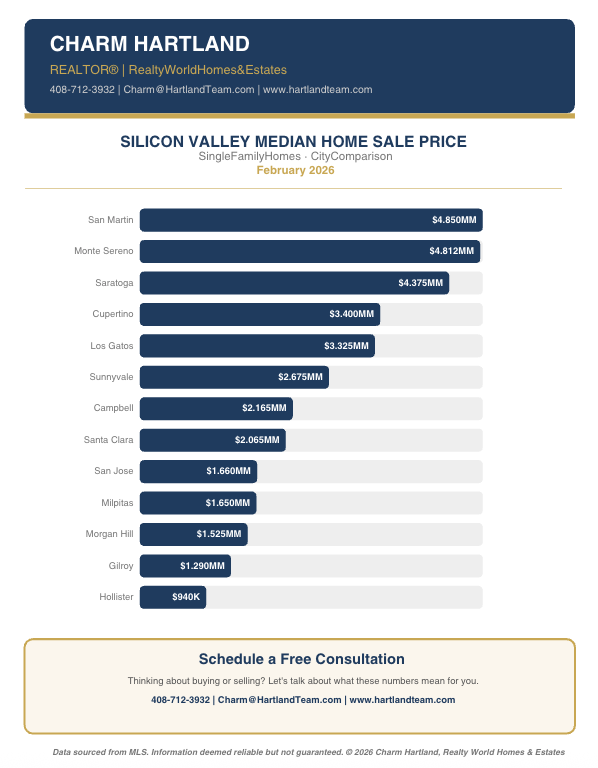
What's The Average Price of a Home in each city of Santa Clara County? Month ending February 2026 - By: Charm Hartland, Realtor


Need to Sell Your Home But You Don't Live There Anymore? By Charm Hartland, Realtor

Need to Sell Your Home But You Don't Live There Anymore?
How to Sell a Home Remotely in Silicon Valley Without Returning to Handle the Details
 
Life changes quickly. A job transfer sends you to another state. Family circumstances shift. Parents transition into assisted living. Sometimes homeowners simply move away while still owning a property in Silicon Valley.
If you find yourself needing to sell a home in Santa Clara County while living somewhere else, the process can feel overwhelming.
 
Common Questions Remote Sellers Ask:
  • Who meets contractors?
  • Who prepares the house for showings?
  • Who coordinates repairs or staging?
  • Who handles buyer inspections and negotiations?
 
The truth is, selling a home remotely requires a local expert who can manage every detail on your behalf. That is exactly what I do for my clients. As a Santa Clara County real estate specialist, I regularly help homeowners sell their properties while they are living in another city, another state, or even another country. My role is simple: I manage the entire process locally so my clients do not have to worry about the details.

Can You Sell a House in Santa Clara County Without Living Here?

Yes. In fact, it is very common. Especially for me. I have actually sold homes for quite a few people I have never met in person! Many homeowners today sell their property remotely because they have:
  • Relocated for a new job
  • Inherited a property
  • Moved to another state for retirement
  • Helped parents transition to assisted living
  • Purchased a new home before selling their previous one
 
With modern technology and the right local representation, homeowners can complete the entire sale without needing to return to Santa Clara County. However, the key to a smooth remote sale is having a trusted professional on the ground managing the property.

Why Remote Home Sales Require a Local Expert

When a seller is not physically present, even small tasks become complicated. For example:
  • Contractors need access to the property
  • Inspections must be scheduled and supervised
  • Deliveries and staging furniture must be received
  • Landscapers and cleaners need direction
  • Buyers may request last-minute walkthroughs
 
Because I am local to Santa Clara County, I act as my clients' eyes, ears, and hands on the ground. My sellers do not have to travel back and forth or worry about coordinating dozens of moving parts from afar.

Preparing Your Santa Clara County Home for Sale

Before a property hits the market, there is often preparation needed to ensure it presents well to buyers. For my out-of-area clients, I coordinate the entire process, which can include:
  • Meeting contractors and overseeing repairs
  • Coordinating painters and cosmetic improvements
  • Arranging deep cleaning and landscaping
  • Managing junk removal and donation of unwanted items
  • Scheduling professional staging
  • Coordinating photography and marketing
 
Throughout the process, I keep my clients updated with photos, videos, and regular communication so they can see the progress without needing to be present.

Marketing Your Home to the Right Buyers

Santa Clara County attracts buyers from around the world, especially in markets like San Jose, Silver Creek Valley, Evergreen, Milpitas, Los Altos, Cupertino, Campbell, and Santa Clara.
To maximize exposure, I create a comprehensive marketing strategy that includes:
  • Professional photography and video
  • Strategic online marketing
  • MLS exposure across the Silicon Valley market
  • Outreach to local buyer agents
  • Targeted digital promotion
This ensures the property reaches serious buyers quickly.

Managing Showings and Negotiations

Once the home is on the market, the process becomes fast-moving. Buyer agents schedule tours. Questions come in. Offers are presented. Negotiations begin.
For my remote sellers, I handle every step of this process, including:
  • Managing showings and buyer agent communication
  • Reviewing offers strategically
  • Negotiating price and terms
  • Coordinating inspections and disclosures
  • Keeping escrow on track
 
My goal is not just to secure the best price, but also to structure the transaction in a way that protects my clients and ensures a smooth closing.

Signing Documents When You Live Out of the Area

Many sellers worry about how they will sign paperwork if they are not local. Fortunately, most real estate transactions today can be completed remotely using secure electronic signatures. When notarization is required, mobile notaries can be arranged anywhere in the country.
This allows my clients to complete the entire transaction from wherever they live.

Handling the Unexpected

Every real estate transaction presents a few surprises. A repair request may arise. A contractor may be needed quickly. A buyer inspection may uncover something that needs attention.
Because I am local, I can respond immediately and coordinate solutions, so my clients do not have to manage those challenges from afar.

Why Out-of-Area Sellers Trust Charm Hartland

Selling a home remotely requires trust. My clients need to know someone is managing their property as carefully as they would themselves.

As a long-time Santa Clara County Realtor and owner of Realty World Homes & Estates, I have built my career on communication, strategy, and attention to detail. Whether my clients live across the state or across the country, they know their property is in capable hands.
 
Thinking About Selling a Santa Clara County Home From Out of the Area?
If you or your family need to sell a home in Santa Clara County but no longer live here, you do not have to manage the process alone. I regularly help out-of-area homeowners prepare, market, and sell their properties while handling all the local details. If you would like to discuss your situation or explore the best strategy for your property, I would be happy to help.
 
Charm Hartland
Realtor and Owner  |  Realty World Homes & Estates
San Jose, CA 95138
408-712-3932   |   Charm@HartlandTeam.com   |   www.HartlandTeam.com


Santa Clara Real Estate Market - What the Numbers Say for Month-Ending February 28, 2026 - By Charm Hartland

The Santa Clara single-family home market remained highly competitive in February 2026, with strong buyer demand continuing to push sale prices well above asking. Here's a snapshot of key metrics compared to the prior month and the same period last year.
 
Single Family Homes February 2026 January 2026 February 2025
Closed Sales 27 20 26
Median Sale Price $2.06M $2.34M $2.2M
Median Days on Market 9 12 7
New Listings 42 38 52
Avg % List Price Rec'd 109% 108% 116%
Avg Sale $/Sq Ft $1,400 $1,465 $1,406
 
Key Takeaways
Sales Activity Picked Up: Closed sales rose to 27 in February, up 35% from 20 in January and slightly above the 26 closings recorded in February 2025.
Median Price Softened Month-over-Month: The median sale price of $2.06M was down from $2.34M in January but also below the $2.2M recorded a year ago, suggesting some moderation in peak pricing.
Homes Are Selling Fast: The median days on market came in at just 9 days, an improvement from 12 days in January, though slightly above the 7-day pace seen in February 2025.
More Inventory Coming to Market: New listings increased to 42, up from 38 in January, though still below the 52 new listings seen in February 2025.
Buyers Continue to Compete Above List: Homes averaged 109% of list price received — above January's 108%, though below the 116% seen a year ago. Overbidding remains the norm.
Price per Sq Ft Holding Steady: At $1,400/sq ft, values are closely in line with the $1,406/sq ft from February 2025, indicating stable underlying value despite some headline price fluctuation.
 
Bottom Line
Santa Clara continues to be a seller's market. Homes are moving quickly, routinely selling over asking price, and inventory remains tight. Whether you're buying or selling, navigating this market requires strategy and local expertise — and that's exactly what I bring to every transaction.
 
Schedule a Free Consultation
Whether you're thinking about buying, selling, or just want to know what your home is worth — I'm here to help.
408-712-3932   Charm@HartlandTeam.com   www.hartlandteam.com
Data sourced from MLS. Information deemed reliable but not guaranteed. | © 2026 Charm Hartland, Realty World Homes & Estates


San Jose's Evergreen Area - Real Estate Market Update - Month ending February 2026 by Charm Hartland, Realtor

CHARM HARTLAND
REALTOR®  |  Realty World Homes & Estates
408-712-3932  |  Charm@HartlandTeam.com  |  www.hartlandteam.com
 
EVERGREEN | SAN JOSE REAL ESTATE
Single Family Home Market Update
February 2026
 
The Evergreen area of San Jose saw continued activity in the single-family home market this month, with inventory rising and homes selling above asking price. Here's how the numbers stack up compared to last month and a year ago.
Single Family Homes This Month Last Month A Year Ago
Closed Sales 16 14 17
Median Sales Price $1.89M $1.40M $2.18M
Median Days on Market 14 12 6
New Listings 40 30 33
Avg % List Price Rec'd 104% 105% 106%
Avg Sale Price per Sq Ft $934 $949 $954
 
 
Key Takeaways

Sales Picked Up Month-over-Month: Closed sales rose to 16 this month, up from 14 last month, though slightly below the 17 closings from a year ago.
Median Price Jumped Significantly: The median sale price surged to $1.89M from $1.40M last month, a 35% increase, though still below the $2.18M recorded a year ago.
Homes Taking Slightly Longer to Sell: Median days on market edged up to 14 days from 12 last month and 6 a year ago, signaling a modest shift toward a more balanced pace.
Inventory Expanded: New listings jumped to 40 this month, up 33% from 30 last month and well above the 33 seen a year ago, giving buyers more options.
Homes Still Selling Above Asking: Buyers paid an average of 104% of list price, just under last month's 105% and a year ago's 106%, but overbidding remains the norm in Evergreen.
Price per Sq Ft Holding Near Prior Levels: At $934/sq ft, values are slightly below last month ($949) and a year ago ($954), a modest softening worth watching.
 
 
Bottom Line
Evergreen remains a competitive market where homes consistently sell above list price. While days on market have ticked up slightly and price per square foot has softened a touch, strong demand and rising inventory suggest an active spring season ahead. If you're thinking about making a move in Evergreen, now is a great time to connect and build a strategy.
 
Schedule a Free Consultation
Whether you're thinking about buying, selling, or just want to know what your Evergreen home is worth, I'm here to help.
408-712-3932   |   Charm@HartlandTeam.com   |   www.hartlandteam.com

Data sourced from MLS. Information deemed reliable but not guaranteed.  |  © 2026 Charm Hartland, Realty World Homes & Estates


Charm's Favorite Corned Beef and Cabbage Recipe

A Quick Background on St. Patrick’s Day

I am proud of my Irish heritage! This March 17th in honor of Saint Patrick, the patron saint of Ireland, I will be wearing green and making corned beef and cabbage!

Interestingly, this dish is actually an Irish American tradition rather than a classic Irish one. When Irish immigrants arrived in America in the 19th century, they found corned beef to be more affordable and available than the bacon commonly eaten in Ireland. They paired it with cabbage, an inexpensive vegetable that absorbs flavor beautifully, and the one pot meal quickly became a St. Patrick’s Day tradition in the United States.


Charm's Favorite Corned Beef and Cabbage Recipe

Ingredients

1 corned beef brisket, 3 to 4 pounds, with spice packet
10 small red potatoes, halved
4 large carrots, cut into chunks
1 large yellow onion, quartered
1 head green cabbage, cut into wedges
3 cloves garlic, smashed
1 bay leaf
6 cups water or beef broth
Optional: 1 bottle Irish stout beer for deeper flavor

Instructions

  1. Rinse the corned beef under cold water to remove excess brine.

  2. Place the brisket in a large Dutch oven or stock pot with the fat side facing up.

  3. Add the spice packet, garlic, onion, bay leaf, and broth or broth with beer.

  4. Bring to a boil, then reduce to a gentle simmer. Cover and cook for about 2½ to 3 hours until the meat becomes tender.

  5. Add the potatoes and carrots and cook for 15 minutes.

  6. Add the cabbage wedges and cook another 10 to 15 minutes until the vegetables are tender.

  7. Remove the brisket, slice against the grain, and serve with the vegetables and some of the broth.

Tips for the Best Flavor

Cook the brisket slowly at a low simmer so it stays tender.
Always slice against the grain for the best texture.
Leftovers are perfect for corned beef hash or a classic Reuben sandwich the next day.


Happy St. Patrick’s Day from Charm Hartland

Charm Hartland
Top 5% Realtor, Santa Clara County
Realty World Homes and Estates
San Jose, CA 95138

408 712 3932
Charm@HartlandTeam.com
www.HartlandTeam.com

Helping Silicon Valley families buy and sell homes with expertise, strategy, and care.


Is Right Now a Good Time to Sell in Evergreen, San Jose? By Charm Hartland, Realtor

I get this question a lot. Especially in spring. People want to know if they missed the boom or if there is still a good opportunity to sell. So let me just tell you what I am actually seeing right now in Evergreen.
Yes, it is still a good time to sell. But you have to be smart about it. The buyers in 95135, 95138, and 95148 are not panicking anymore. They are not throwing crazy money at every house the way they did in 2021. They are being careful. They are comparing homes. They are doing their homework.
That means your home needs to be ready. It needs to be priced right. And you need a real plan. Homes that check those boxes are still selling well and sometimes even getting multiple offers. Homes that do not check those boxes are sitting. And a home that sits too long starts to look like something is wrong with it, even when nothing is.

What Is Happening in Each Part of Evergreen

In 95148, there are not a lot of homes for sale right now. Buyers are actively looking and there is not much to choose from. If your home is in good shape and priced fairly, you are in a strong position.

In 95138 and Silver Creek, we are talking about some of the most expensive homes in San Jose. Sales are slower here just because there are fewer buyers at that price level. But serious buyers are still out there. The key is patience and presentation.

In 95135, most of the condos are inside The Villages, which is a gated 55 and older community. If you are selling there, your buyer pool is specifically people 55 and up. The good news is that The Villages is a genuinely wonderful place to live. Golf, pools, clubs, security, a real sense of community. When you market it right, it sells itself to the right buyer. Just know that it is a targeted audience, not the general public. If you have a single-family home in 95135, you are in a stronger position because you are open to all buyers, not just those 55 and older.

Charm Hartland, Realty World Homes & Estates: 'I have been selling homes in Evergreen for 25 years. The sellers who do best are always the ones who are prepared, not the ones who just want the highest number.'

What You Should Do Before You List

  • Talk to me before you do anything. I will walk your home with you and tell you honestly what needs attention and what does not. No cost, no pressure.
  • Fix the small stuff. Buyers notice a dripping faucet, a scuffed wall, a broken gate. It makes them wonder what else has not been taken care of.
  • Get a pre-inspection done. It sounds scary but it actually protects you. You find out about any issues before the buyer does and you can deal with them on your own terms.
  • Price it right from the start. A home that is overpriced and then reduced looks like a problem. Buyers see the price drop and they start negotiating harder. Price it well the first time and you stay in control.
I am always happy to sit down with you and talk through your specific situation. No sales pitch. Just a real conversation about what your home is worth and what it would take to sell it well this spring.
 
Ready to find out what your Evergreen home is worth this spring? Let's talk.

Charm Hartland

Call or text: 408-712-3932   |   Charm@HartlandTeam.com   |   @CharmHartlandRealtor


What do I need to know about an HOA when buying a home in an HOA Community? By Charm Hartland, Realtor

HOA Clarity: The Hidden Factors That Determine Condo and Townhome Sale Prices in Santa Clara County

In Evergreen and Silver Creek Valley, buyers are not just underwriting the home.

They are underwriting the HOA.

And in today’s market, HOA clarity is no longer optional it is a pricing strategy.

Whether you are selling in The Villages (95135), Silver Creek Valley Country Club, a gated community in 95138, or a townhome development in 95148, the strength and transparency of your homeowners association can directly impact:

  • Buyer confidence

  • Appraisal support

  • Lending approval

  • Days on market

  • Final sale price

In attached housing, uncertainty equals leverage loss.

Let’s break down what HOA clarity actually means and why it matters more than ever this spring.


What Is HOA Clarity?

HOA clarity is the elimination of financial, legal, and governance uncertainty before a buyer discovers it.

When documentation is incomplete or unclear, buyers assume risk.

When buyers assume risk, they reduce price.

Luxury buyers especially are risk-sensitive. They expect stability, predictability, and professional management. If they sense instability, they move on — or they negotiate aggressively.

In Evergreen, where lifestyle and long-term living are central to purchase decisions, this becomes even more critical.


The Six Pillars of HOA Clarity

1. Financial Health Transparency

Buyers want immediate visibility into:

  • Reserve balances

  • Reserve funding percentage

  • History of special assessments

  • Upcoming capital improvement projects

  • Litigation exposure

Underfunded reserves raise red flags. Pending large projects without funding create pricing pressure.

In gated and 55+ communities, strong reserves are a signal of responsible governance and buyers pay attention.


2. Special Assessment Disclosure

Nothing derails escrow faster than surprise assessments.

Even rumors of roof replacement, elevator upgrades, or road resurfacing can create:

  • Renegotiations

  • Buyer withdrawal

  • Appraisal hesitation

Clarity means confirming in writing whether special assessments are pending or under discussion. Transparency protects the transaction.


3. Litigation Status

Active litigation can:

  • Narrow the buyer pool

  • Disqualify certain lenders

  • Delay closing timelines

Townhomes in 95135, 95148 and attached homes in 95138 are particularly sensitive to this issue.

A clean litigation status expands financing options and strengthens your negotiating position.


4. Insurance Coverage

Since insurance markets tightened across California, this has become one of the most scrutinized areas in HOA review.

Buyers want to understand:

  • Master policy limits

  • Deductibles

  • Coverage exclusions

  • Recent premium increases

In higher-value communities, inadequate insurance coverage creates lender hesitation and buyer anxiety.

Clarity here creates stability.


5. Governance and Lifestyle Rules

In The Villages (95135), governance is not a side issue it is central to the lifestyle.

Buyers review:

  • Rental restrictions

  • Architectural guidelines

  • Pet rules

  • Parking regulations

  • Short-term rental policies

When expectations are clearly set before offer submission, transactions move smoothly. When buyers discover restrictions late, negotiations stall.


6. Document Presentation and Organization

Presentation matters.

Simply delivering a stack of PDFs is not clarity.

Professional HOA clarity includes:

  • A clean summary sheet

  • Highlighted reserve study data

  • Confirmed insurance snapshot

  • Written litigation statement

  • Simplified explanation for buyers

This level of organization signals professionalism. And professionalism influences buyer confidence.


Why HOA Clarity Is a Luxury Advantage

In 95138, buyers are purchasing more than square footage.

They are purchasing:

  • Stability

  • Lifestyle

  • Governance quality

  • Financial predictability

If your HOA story is clean, organized, and strong, you create confidence.

Confidence drives stronger offers.

In contrast, uncertainty invites caution. And cautious buyers write conservative offers.


The Seller Advantage

For sellers in 95135, 95138, and 95148, preparing HOA documentation before listing does three powerful things:

  1. Reduces contingency periods

  2. Minimizes renegotiation risk

  3. Preserves pricing leverage

In a spring market where momentum matters, preventing friction is strategic.


The Buyer Advantage

For buyers, properly reviewing HOA documentation prevents:

  • Surprise assessments

  • Insurance complications

  • Financing issues

  • Post-close frustration

In attached housing, due diligence is not optional. It is foundational.


Final Thoughts

In Evergreen and Silver Creek, the market is sophisticated.

If you are buying or selling a condo or townhome in 95135, 95138, or 95148, HOA clarity is not just paperwork it is a pricing and leverage strategy.

When the HOA story is clean, transactions move confidently.

And confidence protects value.


If you are preparing to list or evaluating a purchase I provide a pre-listing HOA review and buyer-side HOA risk analysis so you can move forward with clarity and precision.

Let’s design your strategy.

Charm Hartland
Realty World Homes & Estates
Evergreen & Silver Creek Specialist
408-712-3932
Charm@HartlandTeam.com


Having “The Talk” With Aging Parents: Why a Senior Real Estate Specialist Matters, by Charm Hartland, Realtor

Having “The Talk” With Aging Parents: Why a Senior Real Estate Specialist Matters

Few conversations in life are as emotional as talking with aging parents about a potential move to assisted living. For many families, this discussion comes after months—or even years—of quiet concern. Maybe you’ve noticed deferred home maintenance, unopened mail, missed medications, or the simple reality that daily living alone has become harder.

Maybe you’ve noticed deferred home maintenance, unopened mail, missed medications, or the simple reality that daily living alone has become harder.

For your parents, their home often represents far more than a place to live. It holds decades of memories, milestones, and family history. In some cases, generations have passed through the same home. Letting go can feel overwhelming and sometimes frightening.

This is where a Senior Real Estate Specialist (SRES) like myself can make a meaningful difference.

It’s Not Just a Real Estate Decision

Moving to assisted living is not just a housing change. It’s a major life transition involving:

·       Emotional readiness

·       Financial considerations

·       Health and safety needs

·       Family dynamics

·       Estate or trust planning

·       Sorting through a lifetime of belongings

A traditional real estate approach often focuses only on the sale. A Senior Real Estate Specialist understands the bigger picture.

A Compassionate, Step-by-Step Approach

An SRES is trained to guide families through senior transitions with patience and sensitivity. This includes:

1. Reducing Emotional Stress

Seniors may feel loss of independence, fear of change, or grief about leaving their home. A specialist knows how to communicate respectfully and move at a comfortable pace.

2. Creating a Realistic Plan

Many older adults have deferred maintenance or repairs they can no longer manage. An SRES helps families decide what is truly worth fixing and what can be sold as-is, preventing unnecessary expense and stress.

3. Coordinating Support Services

Senior moves often require more than a moving truck. Families may need:

·       Downsizing help

·       Estate sale coordination

·       Packing and sorting assistance

·       Clean-out services

·       Connections to senior living advisers who know the communities available

A strong SRES has a network of trusted professionals to support each step.

4. Understanding Financial Options

A home is often a senior’s largest asset. A specialist can help families explore how home equity may help fund assisted living, care, or future needs—while working alongside financial advisors or fiduciaries when appropriate.

Preserving Dignity and Choice

One of the greatest benefits of involving a Senior Real Estate Specialist early is preserving your parents’ sense of control. When seniors feel included in decisions, the transition is often smoother and less traumatic.

The goal is not to “move them out.”
The goal is to help them move forward safely, comfortably, and with dignity.

You Don’t Have to Do This Alone

Families often feel they must figure everything out themselves. In reality, this transition is easier—and kinder—when guided by someone experienced in senior moves.

A Senior Real Estate Specialist serves as a calm, knowledgeable partner who understands both the emotional and practical sides of the journey.

Having the talk is hard.
Having the right support makes it easier.

A Gentle Next Step for Your Family

If your family is starting to think about senior living options, you don’t have to navigate this alone. The earlier you have the right guidance, the more choices and peace of mind you’ll have.

I specialize in helping seniors and their families through thoughtful, well-planned transitions. From coordinating downsizing and preparing a home for sale to connecting you with trusted senior living resources, my goal is to make this process as smooth and respectful as possible for everyone involved.

Every family’s situation is unique, and I’m here to listen first, then help you build a plan that supports your parents’ safety, comfort, and dignity.

Let’s have a confidential, no-pressure conversation about your options.

Charm Hartland
408-712-3932

Senior Real Estate Specialist (SRES)
Realty World Homes & Estates

Helping Silicon Valley families navigate senior transitions with care, clarity, and compassion.

Reach out when you’re ready. Even a simple conversation can bring clarity and relief.


Santa Clara County Real Estate Market Update – Month Ending January 2026 - by Charm Hartland, Realtor

Santa Clara County Real Estate Market Update – Month Ending January 2026

By Charm Hartland | Realty World Homes & Estates
January is always a “reset” month in Silicon Valley real estate; new inventory starts to build, buyers re-engage after the holidays, and the market begins warming up for the spring selling season. This year, January 2026 delivered a clear message: demand is still there, but buyers are more selective, and pricing + preparation matter more than ever.
 

January 2026 Snapshot (Santa Clara County)

Single-Family Homes (Resale)

  • New listings: 686
  • Active inventory (end of month): 591
  • Closed sales: 312
  • Average days on market: 32
  • Average sale price: $2,207,361
  • Median sale price: $1,745,000
  • Median $/SqFt: $1,052
  • Average % of list price received: 103%

Condos & Townhomes

  • New listings: 503
  • Active inventory (end of month): 623
  • Closed sales: 156
  • Average days on market: 61
  • Average sale price: $987,318
  • Median sale price: $886,944
  • Median $/SqFt: $707
  • Average % of list price received: 100%
What that tells us: Single-family homes are still moving quickly and often selling over list, while condos/townhomes are taking longer and behaving closer to a balanced market.
 

City Highlights (Selected)

A few “headline” medians from January closed sales:
  • San Jose (SFR): median $1,500,000, avg DOM 27, ~103% list price received
  • Sunnyvale (SFR): median $2,820,000, avg DOM 30, ~109% list price received
  • Palo Alto (SFR): median $3,325,000, avg DOM 39, ~107% list price received
  • Santa Clara (SFR): median $2,289,000, avg DOM 16, ~107% list price received
On the attached condo/townhome side, San Jose posted a median of $770,000 with a longer 61-day average market time another sign that buyers are value-conscious in that segment.
 

What Buyers Did in January (And Why It Matters for Spring)

Even when headlines talk about slower national sales, Silicon Valley behaves differently because well-priced, well-presented homes still trigger competition.
Nationally, January 2026 existing-home sales fell and homes took longer to sell, reflecting affordability pressure and seasonal factors.

Locally, the single-family segment still averaged 103% of list price received countywide.
My read: Buyers are showing up, but they’re not “overpaying for problems.” They’ll compete aggressively for turn-key homes, great locations, and strong school areas, but they negotiate harder when condition, disclosures, or pricing don’t line up.
 

Spring 2026 Selling Season Predictions (What I Expect Next)

Here’s what January data typically signals as we head into March–May, plus what we’re seeing in early 2026 conditions:

1) Inventory should rise, then the best homes will separate quickly

January already posted 686 new single-family listings countywide, and spring usually increases that pace. More choices doesn’t automatically mean “easy” for buyers, it often means buyers become pickier, and only the best-positioned homes sell fast and above list.

2) Multiple offers will likely remain common for “A” homes

When the county is averaging 103% list price received on single-family homes, that’s not a sleepy market. If mortgage rates stay even moderately stable, spring demand typically expands faster than supply for top-tier homes.

3) Condos/townhomes may stay more negotiable than single-family

With 61 average DOM and 100% list price received in January, the attached-home segment is signaling more balance. That often translates into: more price reductions, more credits, and more room to negotiate, especially on condition and HOA-related concerns.

4) Prices: modest upward pressure, but not a straight line

The California Association of REALTORS® forecast called for a modest statewide price increase in 2026. In Santa Clara County, expect pricing to be hyper-local: schools, commute patterns, property condition, and micro-neighborhood inventory will matter more than broad county averages.

What Sellers Should Do Now (To Win in Spring)

If you’re planning to list in March, April, or May:
  • Pre-inspect + pre-plan: Know your roof, pest, sewer lateral, HVAC, and disclosure story before the market tells it for you.
  • Upgrade strategically: paint, lighting, staging, landscaping, and cosmetic fixes still punch above their weight, especially when buyers are selective.
  • Price for impact: In this market, correct pricing is what creates competition (and often the best outcome).
  • Timing matters: Your best window is when your home will look and show its best, then marketing can do its job.
 

What Buyers Should Do Now (To Compete Smartly)

  • Update underwriting (not just pre-approval) so you can move fast when the right home hits.
  • Be ready for two markets at once: you may negotiate on one home and compete hard on the next depending on condition and pricing.
  • Target strategy over emotion: win with clean terms, strong credibility, and a smart pricing plan not just the highest number.

Bottom Line

January 2026 showed a market that’s active, competitive in single-family homes, and more measured in condos/townhomes, a classic setup for a busy spring in Santa Clara County. The buyers are out there. The opportunities are real. And the winners this spring will be the people who prepare early and act strategically.

Call to Action

If you’re thinking about selling this spring or buying while you still have negotiating room in certain segments, reach out and I’ll put together a custom strategy and pricing plan for your home.

Charm Hartland
Realtor/Owner, Realty World Homes & Estates
San Jose, CA 95138


Smart Home Improvements: What Adds Value and What Doesn’t When You Sell, by Charm Hartland, Realtor

Smart Home Improvements: What Adds Value and What Doesn’t When You Sell

By Charm Hartland
Realty World Homes & Estates

When homeowners start thinking about selling, one of the first questions they ask is:

“What should I fix or upgrade before I put my home on the market?”

It’s a great question, because the right improvements can positively impact your sale price and marketability, while the wrong ones can cost a lot and deliver little return.

Let’s start with an important truth:

Home improvements are first for your enjoyment while living in the home.
If a move might be in your future, being strategic can protect your equity and maximize your return.

As a Realtor in Santa Clara County, I regularly guide sellers through this decision process. Not every upgrade is worth the investment, and some can actually reduce buyer appeal.

Here’s how to think about it.


The Golden Rule of ROI

The best return on investment comes from improvements that:

  • Appeal to the widest number of buyers

  • Make a home feel clean and move in ready

  • Modernize without over personalizing

  • Fit neighborhood expectations

ROI is about buyer perception, not just dollars spent.


Home Improvements With the BEST ROI

1) Fresh Interior Paint

One of the highest impact, lowest cost improvements.

Stick with:

  • Warm whites

  • Light neutrals

  • Soft, natural tones

These make spaces feel bigger, brighter, and more inviting.


2) Curb Appeal

First impressions matter.

Strong ROI updates include:

  • Fresh mulch and tidy landscaping

  • Trimmed trees and shrubs

  • A clean entryway

  • A freshly painted or updated front door

Buyers often form opinions before they even walk inside.


3) Kitchen Refreshes (Not Full Remodels)

You don’t always need a full renovation.

High ROI updates:

  • Painted or refaced cabinets

  • New hardware

  • Updated lighting

  • Modern faucet

  • Fresh countertops if dated

A bright, functional kitchen sells homes.


4) Bathroom Updates

Bathrooms influence buyer decisions more than many realize.

Smart updates:

  • New vanity, mirror, and lighting together

  • Updated fixtures

  • Fresh grout and caulking

  • Neutral, spa like colors

A cohesive update feels like a true upgrade.


5) Flooring Improvements

Worn floors signal deferred maintenance.

Great investments:

  • Refinishing hardwood floors

  • Replacing heavily worn carpet

  • Consistent flooring in main living areas

Clean, cohesive flooring elevates the entire home.


6) Pre Sale Preparation

Often the biggest ROI of all:

  • Professional cleaning

  • Decluttering

  • Light staging

Presentation matters more than perfection.


Home Improvements With the WORST ROI

1) Major Remodels Right Before Selling

A full kitchen or bathroom gut remodel right before listing often disappoints.

Why?

  • You pay retail for the work

  • Buyers may not share your taste

  • You rarely recover full cost

A refresh usually beats a renovation.


2) Highly Personalized Design Choices

Examples:

  • Bold paint colors

  • Statement wallpaper

  • Trendy tile patterns

  • Ultra modern finishes in traditional neighborhoods

The more specific your taste, the smaller your buyer pool.


3) Swimming Pools

Pools are lifestyle upgrades, not financial ones.

They can:

  • Limit buyer interest

  • Add maintenance concerns

  • Increase insurance costs

In some luxury segments they help, but they rarely return dollar for dollar value.


4) Garage Conversions

Turning garages into living space often hurts value.

Buyers want:

  • Parking

  • Storage

  • EV charging space

Losing a garage can be a deal breaker.


5) Over the Top Landscaping

Beautiful landscaping is great, but:

  • Elaborate gardens

  • Specialty plants

  • Expensive hardscaping

These rarely return their cost.

Clean and tidy wins.


6) Top of the Line Appliances

Luxury appliances are nice but:

  • Buyers expect them only in certain price points

  • Mid range often feels just as appealing

  • Technology becomes outdated quickly

You usually won’t recoup the premium.


The Smart Seller Strategy

Before investing in upgrades, it’s best to get local, market specific advice.

Every neighborhood is different.
Every price point is different.
Every home is different.

The smartest sellers improve strategically rather than emotionally.


Final Thought

In Santa Clara County, buyers often prioritize:

  • Location

  • Floor plan

  • Natural light

  • Overall condition

  • School districts

A well prepared home in a great location can outperform a heavily remodeled home in a weaker location.

If you’re thinking about selling and want guidance on where to invest and where not to, I’m happy to help you create a plan that protects your equity and positions your home for success.

A short consultation can save thousands in unnecessary upgrades. Reach out to me today and we can get started.

Charm Hartland
Realty World Homes & Estates
Charm@HartlandTeam.com
408-712-3932


We use cookies to provide you the best experience on our website. Click here to view our privacy policy. By continuing to use this site we assume your consent to receive cookies.